Difference between revisions of "MUD"
| Line 7: | Line 7: | ||
Long before open-world maps and cinematic cut scenes, there was another way to play a role-playing game: through words. You type a command, read a description of the world around you, decide what to do next — and slowly discover the world is far larger than it first appeared. There are monsters to fight, places to explore, quests to unravel, and other players sharing the same world with you. |
Long before open-world maps and cinematic cut scenes, there was another way to play a role-playing game: through words. You type a command, read a description of the world around you, decide what to do next — and slowly discover the world is far larger than it first appeared. There are monsters to fight, places to explore, quests to unravel, and other players sharing the same world with you. |
||
These games are called '''MUDs''' |
These games are called '''MUDs,''' and by modern graphical standards they look impossibly simple. That simplicity is exactly what makes them worth a look. |
||
=== The Basics === |
=== The Basics === |
||
| Line 17: | Line 17: | ||
<blockquote>You stand at the edge of an ancient forest. A narrow trail disappears between the trees to the north. To the east, a weathered stone road leads toward distant hills.</blockquote> |
<blockquote>You stand at the edge of an ancient forest. A narrow trail disappears between the trees to the north. To the east, a weathered stone road leads toward distant hills.</blockquote> |
||
Instead of clicking, you type <code>north</code> |
Instead of clicking, you type <code>north,</code>and the game answers with another description. You can examine objects, talk to characters, fight creatures, trade, solve puzzles, join [[Clans|clans]], and interact with the other people playing alongside you. The result is part RPG, part interactive fiction, part adventure, and part living online community. |
||
<div style="text-align:center; font-style:italic; font-size:0.9em;"></div> |
<div style="text-align:center; font-style:italic; font-size:0.9em;"></div> |
||
The crucial ingredient is '''persistence'''. Unlike a single-player text adventure that exists only for your character, a MUD keeps going after you log off. The person you met yesterday may still be there tomorrow. A town you visited might have changed. Someone might have discovered a new area, or your character's reputation might have started to mean something. The world isn't a sequence of levels waiting for you |
The crucial ingredient is '''persistence'''. Unlike a single-player text adventure that exists only for your character, a MUD keeps going after you log off. The person you met yesterday may still be there tomorrow. A town you visited might have changed. Someone might have discovered a new area, or your character's reputation might have started to mean something. The world isn't a sequence of levels waiting for you; it's a ''place''. |
||
=== A Very Brief History === |
=== A Very Brief History === |
||
| Line 27: | Line 27: | ||
The roots reach back to the 1970s, when ''Colossal Cave Adventure'' established the idea of exploring a computer-generated world through written commands. Then in 1978, Roy Trubshaw and Richard Bartle began building the original MUD at the University of Essex, adding the one thing text adventures lacked: multiple people inhabiting the same world at once. |
The roots reach back to the 1970s, when ''Colossal Cave Adventure'' established the idea of exploring a computer-generated world through written commands. Then in 1978, Roy Trubshaw and Richard Bartle began building the original MUD at the University of Essex, adding the one thing text adventures lacked: multiple people inhabiting the same world at once. |
||
As networks spread, so did MUDs, and they branched into distinct traditions |
As networks spread, so did MUDs, and they branched into distinct traditions, some built around combat and character progression, others around roleplay and social life, still others handing players the tools to build the world themselves. The early 1990s brought structured systems like DikuMUD that codified levels, classes, equipment, and quests. |
||
Sound familiar? Persistent characters, shared worlds, [[Guilds|guilds]], economies, player communities |
Sound familiar? Persistent characters, shared worlds, [[Guilds|guilds]], economies, player communities -- the graphical online RPGs that came later inherited nearly all of it from text. The technology changed. The underlying idea didn't: A world drawn in characters rather than pixels. |
||
== Why Play One Today? == |
== Why Play One Today? == |
||
| Line 37: | Line 37: | ||
'''Your imagination is part of the game.''' A forest described as ''ancient, enormous, and haunted'' looks different in your head than in anyone else's. You aren't shown a world so much as handed one to interpret, which makes exploration feel unusually personal. |
'''Your imagination is part of the game.''' A forest described as ''ancient, enormous, and haunted'' looks different in your head than in anyone else's. You aren't shown a world so much as handed one to interpret, which makes exploration feel unusually personal. |
||
'''There's room for real depth.''' Text is exceptionally good at carrying information |
'''There's room for real depth.''' Text is exceptionally good at carrying information: the history of a ruined city, the temperament of a stranger, the properties of a strange artifact, all without needing a cinematic to deliver it. That makes MUDs a natural home for worlds with deep lore and long, complicated histories. |
||
'''Discovery is genuine.''' Graphical games tend to make it obvious where you can go and what matters. A MUD often won't. You experiment, ask questions, search somewhere unexpected, remember a detail from hours ago. Sometimes the game simply doesn't tell you what's important |
'''Discovery is genuine.''' Graphical games tend to make it obvious where you can go and what matters. A MUD often won't. You experiment, ask questions, search somewhere unexpected, remember a detail from hours ago. Sometimes the game simply doesn't tell you what's important. You have to figure it out, and even a small discovery can feel earned. |
||
'''The community is part of the world.''' These worlds are populated by people, not just scripted characters |
'''The community is part of the world.''' These worlds are populated by people, not just scripted characters; allies, rivals, merchants, guildmates, and familiar faces you keep running into. Because communication is built into the game, experienced [[People|players]] accumulate stories, secrets, and lore that newcomers learn over time. The community becomes part of the content. |
||
'''It's light and it's yours.''' No high-end graphics card, no enormous download, no mandatory intro cinematic. That makes a MUD easy to drop into for a few minutes or settle into for hours |
'''It's light and it's yours.''' No high-end graphics card, no enormous download, no mandatory intro cinematic. That makes a MUD easy to drop into for a few minutes or settle into for hours -- and easy to return to for years. |
||
== Getting Started == |
== Getting Started == |
||
| Line 49: | Line 49: | ||
✦ ✧ ✦ |
✦ ✧ ✦ |
||
If you've never played one, the approach is simple: find a world that sounds interesting and try it. Don't worry about memorizing commands or understanding everything at once. Explore. Read the descriptions. Talk to people. Try things. The first few minutes may feel unfamiliar |
If you've never played one, the approach is simple: find a world that sounds interesting and try it. Don't worry about memorizing commands or understanding everything at once. Explore. Read the descriptions. Talk to people. Try things. The first few minutes may feel unfamiliar, that's normal. Once the basic commands become second nature, the interface fades and what's left is the interesting part: the world itself. |
||
For a quick start with Astaria, check the [[Newbie guide|Newbie Guide]], learn about [[Races|fantasy races and character creation]], or browse our [[Guilds|guilds and classes]]. You can also find [[Resources|connection instructions for telnet and mudlet clients]]. |
For a quick start with Astaria, check the [[Newbie guide|Newbie Guide]], learn about [[Races|fantasy races and character creation]], or browse our [[Guilds|guilds and classes]]. You can also find [[Resources|connection instructions for telnet and mudlet clients]]. |
||
| Line 57: | Line 57: | ||
✦ ✧ ✦ |
✦ ✧ ✦ |
||
And if you're looking for a modern fantasy world to explore, you're welcome to try '''Astaria''' |
And if you're looking for a modern fantasy world to explore, you're welcome to try '''Astaria''', a persistent, text-based RPG built around exploration, character progression, combat, and a world that has been quietly growing since 1994. If discovering a place through words sounds appealing, it's a good place to begin your own adventure. |
||
We are more than just a Multi-User Dungeon. We're a community of memorable [[Places|places]], [[People|people]], and of course, the [[Wizards|wizards]] who build and maintain our world. [[Help newbieareas|New player areas]] are welcoming, and the [[Everyday Astaria|community]] is here to help you find your way. |
We are more than just a Multi-User Dungeon. We're a community of memorable [[Places|places]], [[People|people]], and of course, the [[Wizards|wizards]] who build and maintain our world. [[Help newbieareas|New player areas]] are welcoming, and the [[Everyday Astaria|community]] is here to help you find your way. |
||
Revision as of 08:19, 28 September 2026
What Is a MUD?
Long before open-world maps and cinematic cut scenes, there was another way to play a role-playing game: through words. You type a command, read a description of the world around you, decide what to do next — and slowly discover the world is far larger than it first appeared. There are monsters to fight, places to explore, quests to unravel, and other players sharing the same world with you.
These games are called MUDs, and by modern graphical standards they look impossibly simple. That simplicity is exactly what makes them worth a look.
The Basics
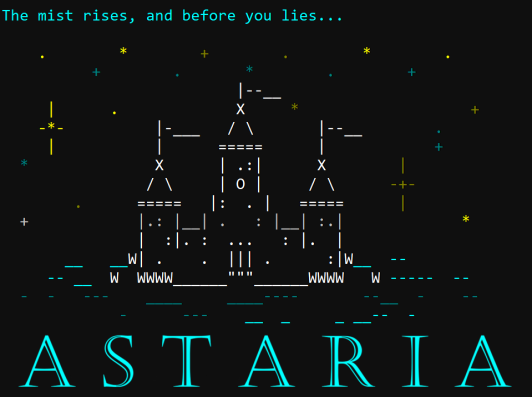
MUD originally stood for Multi-User Dungeon. Today the term covers a broad family of online worlds, most of them primarily text-based, in which the game describes the world to you rather than rendering it on a screen. You might see:
You stand at the edge of an ancient forest. A narrow trail disappears between the trees to the north. To the east, a weathered stone road leads toward distant hills.
Instead of clicking, you type north,and the game answers with another description. You can examine objects, talk to characters, fight creatures, trade, solve puzzles, join clans, and interact with the other people playing alongside you. The result is part RPG, part interactive fiction, part adventure, and part living online community.
The crucial ingredient is persistence. Unlike a single-player text adventure that exists only for your character, a MUD keeps going after you log off. The person you met yesterday may still be there tomorrow. A town you visited might have changed. Someone might have discovered a new area, or your character's reputation might have started to mean something. The world isn't a sequence of levels waiting for you; it's a place.
A Very Brief History
The roots reach back to the 1970s, when Colossal Cave Adventure established the idea of exploring a computer-generated world through written commands. Then in 1978, Roy Trubshaw and Richard Bartle began building the original MUD at the University of Essex, adding the one thing text adventures lacked: multiple people inhabiting the same world at once.
As networks spread, so did MUDs, and they branched into distinct traditions, some built around combat and character progression, others around roleplay and social life, still others handing players the tools to build the world themselves. The early 1990s brought structured systems like DikuMUD that codified levels, classes, equipment, and quests.
Sound familiar? Persistent characters, shared worlds, guilds, economies, player communities -- the graphical online RPGs that came later inherited nearly all of it from text. The technology changed. The underlying idea didn't: A world drawn in characters rather than pixels.
Why Play One Today?
✦ ✧ ✦
Your imagination is part of the game. A forest described as ancient, enormous, and haunted looks different in your head than in anyone else's. You aren't shown a world so much as handed one to interpret, which makes exploration feel unusually personal.
There's room for real depth. Text is exceptionally good at carrying information: the history of a ruined city, the temperament of a stranger, the properties of a strange artifact, all without needing a cinematic to deliver it. That makes MUDs a natural home for worlds with deep lore and long, complicated histories.
Discovery is genuine. Graphical games tend to make it obvious where you can go and what matters. A MUD often won't. You experiment, ask questions, search somewhere unexpected, remember a detail from hours ago. Sometimes the game simply doesn't tell you what's important. You have to figure it out, and even a small discovery can feel earned.
The community is part of the world. These worlds are populated by people, not just scripted characters; allies, rivals, merchants, guildmates, and familiar faces you keep running into. Because communication is built into the game, experienced players accumulate stories, secrets, and lore that newcomers learn over time. The community becomes part of the content.
It's light and it's yours. No high-end graphics card, no enormous download, no mandatory intro cinematic. That makes a MUD easy to drop into for a few minutes or settle into for hours -- and easy to return to for years.
Getting Started
✦ ✧ ✦
If you've never played one, the approach is simple: find a world that sounds interesting and try it. Don't worry about memorizing commands or understanding everything at once. Explore. Read the descriptions. Talk to people. Try things. The first few minutes may feel unfamiliar, that's normal. Once the basic commands become second nature, the interface fades and what's left is the interesting part: the world itself.
For a quick start with Astaria, check the Newbie Guide, learn about fantasy races and character creation, or browse our guilds and classes. You can also find connection instructions for telnet and mudlet clients.
Astaria: A Living World
✦ ✧ ✦
And if you're looking for a modern fantasy world to explore, you're welcome to try Astaria, a persistent, text-based RPG built around exploration, character progression, combat, and a world that has been quietly growing since 1994. If discovering a place through words sounds appealing, it's a good place to begin your own adventure.
We are more than just a Multi-User Dungeon. We're a community of memorable places, people, and of course, the wizards who build and maintain our world. New player areas are welcoming, and the community is here to help you find your way.
